 Discounts on Package Ads
Electric cars VS hybrid cars in India 2026 complete comparison guide
Drive Green Drive Smart
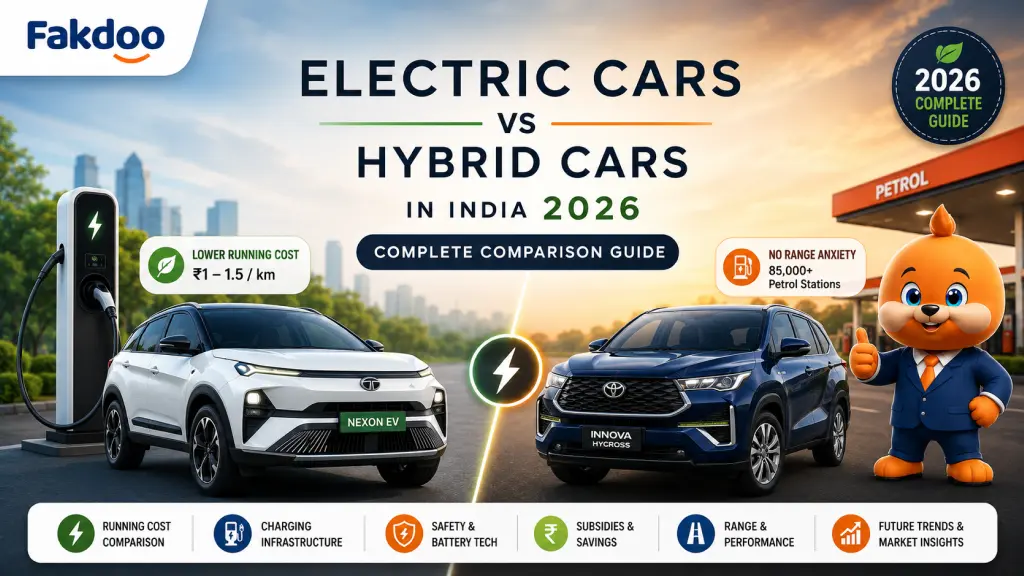
India’s automobile market is at a pivotal moment with petrol prices exceeding Rs 100/litre, stricter BS6 Phase II norms, and growing EV charging infrastructure. Buyers in 2026 face the key decision: buy an electric car or choose a hybrid?
Key Stats for India EV Market 2026:
- 22% EV growth year-on-year (up from 15% in 2024)
- Rs 1.5 to 2 lakh average annual fuel savings switching to EVs
- 30% new car sales target for electric or hybrid by 2030
- 18,000+ public EV charging stations across India
- Electric car sales crossed 2.5 lakh units in 2025
- Hybrid car sales growing 3x annually
TYPES OF HYBRID VEHICLES
Hybrid cars combine a petrol engine with an electric motor and battery, with four main types in India:
Mild Hybrid (MHEV):
- Electric motor assists petrol engine, cannot power car alone
- Fuel efficiency improved by 10–15%
- No external charging, self-charging via regenerative braking
- Examples: Maruti Suzuki Baleno, Grand Vitara; Honda City, Ciaz
- Ideal for buyers wanting mild fuel savings with minimal cost increase
Full Hybrid / Strong Hybrid (HEV):
- Can drive on electric motor alone at speeds up to 40–50 km/h
- Battery recharges automatically, no external charging needed
- Fuel efficiency 21–23 km/l in city traffic
- Examples: Toyota Innova Hycross, Camry; Maruti Grand Vitara
- Best for city commuters wanting max fuel savings without EV hassle
Plug-in Hybrid (PHEV):
- Larger battery charged externally via home/public chargers
- 40–80 km pure electric range for daily use
- Petrol engine activates beyond battery range
- Expected price Rs 25–40 lakh by mid-2026
- Suitable for buyers with home charging and long weekend drives
Series Hybrid (Range Extender):
- Petrol engine only generates electricity; wheels driven by electric motor
- Smoothest EV-like driving feel among hybrids
- Rare in India but growing globally
- Best for buyers wanting EV feel with zero range anxiety
MOST POPULAR ELECTRIC CAR BRANDS IN INDIA 2026
Tata Motors (Market Leader):
- Models: Nexon EV, Punch EV, Tiago EV, Curvv EV
- Market share: 55%+
- Nexon EV: Rs 14.49 lakh, range up to 465 km
- Strong service network, best FAME-II subsidy use
MG Motor (Best Value):
- Models: Windsor EV, ZS EV, Comet EV
- Windsor EV offers Battery-as-a-Service (BaaS) cutting upfront cost
- Effective price under Rs 10 lakh with BaaS
Hyundai (Best Features):
- Models: Creta Electric, Ioniq 5, Kona Electric
- Creta Electric: Rs 17.99 lakh+, 473 km range
- V2L feature (car as power bank)
BYD (Best Range & Safety):
- Models: Atto 3, Seal, e6
- Atto 3 range: 521 km, Blade battery with high safety
Kia (Premium EV):
- Models: EV6, EV9, EV3 arriving 2026
- Ultra-fast 800V charging; EV6 range 528 km
Mercedes-Benz (Luxury EV):
- Models: EQS, EQB, EQA, EQE
- EQS range 700+ km, luxury features
EV CHARGING INFRASTRUCTURE IN INDIA 2026
AC Slow Charging (Level 2):
- 3.3 – 7.4 kW; 6–10 hours full charge
- Home charger cost Rs 8,000–25,000
- Electricity cost Rs 6–8/unit; monthly Rs 900–1,400 for 1,500 km
- Available at homes, offices, hotels
DC Fast Charging (Level 3):
- 30 – 150 kW (some 240 kW chargers)
- 30–60 minutes to 80% charge
- Public cost Rs 15–25 per kWh; ~Rs 300–600 full charge cost
- Locations: malls, fuel stations, highways
- Top Networks: Tata Power EV (5,000+ points), Statiq, EESL, ChargePoint, OKSOL, Charge Zone
- Highway Corridors: Mumbai-Pune every 25 km, Delhi-Agra every 30 km, Bengaluru-Chennai every 40 km, Delhi-Jaipur fully covered
- Home Charging: 82% of EV charging done at home; apartment permissions remain a key challenge
BENEFITS OF HYBRID CARS IN INDIA
- No Range Anxiety: Can refuel at 85,000+ petrol stations across India
- Best-in-Class Fuel Efficiency: Toyota Innova Hycross achieves 21–23 km/l; Maruti Grand Vitara 19–21 km/l
- Lower CO2 Emissions: 25–40% less than petrol cars, meets BS6 Phase II norms
- Regenerative Braking: Converts braking energy into electricity; recovers 15–20% energy in city traffic
- Low Running Costs: Rs 1.8–2.5/km vs Rs 7–9/km for petrol; zero charging infrastructure needed
- Simple Ownership: No charging hassles; service at authorized workshops; durable batteries
- State Tax Benefits: Andhra Pradesh, Gujarat, Karnataka, Maharashtra, Rajasthan, Telangana offer road tax incentives
PLUG-IN HYBRID (PHEV) VS BATTERY ELECTRIC VEHICLE (BEV)
PHEV:
- Electric range 40–80 km; petrol backup for long trips
- Requires external charging
- Rs 1.5–2/km running cost if charged regularly
- Price Rs 25–45 lakh
- Ideal for daily commute below 60 km + weekend drives
- CO2 reduction up to 50% if charged regularly
- Advantage: No range anxiety
BEV:
- Electric range 300–600 km
- Requires home or public charging
- Rs 1–1.5/km running cost
- Price Rs 10.99 lakh to Rs 1.5 crore+
- Suited for urban daily commutes under 120 km
- Zero tailpipe emissions
- Advantage: Lowest lifetime running cost
Verdict for 2026: BEVs are best for urban users with home charging; hybrids/PHEVs better for long-distance or limited charging areas.
ELECTRIC VEHICLE BATTERY TECHNOLOGY 2026
LFP (Lithium Iron Phosphate):
- Used by Tata, MG
- Very safe, 3,000–4,000 cycles
- Better heat tolerance, slightly less range
- Affordable and reliable for Indian climate
NMC (Nickel Manganese Cobalt):
- Used by Hyundai, Kia, MG ZS EV
- Higher energy density, faster charging
- More heat sensitive, costlier
BYD Blade Battery:
- LFP design with flat blade cells
- Passes nail penetration safety test
- Space efficient, minimal degradation after 2 lakh km
Solid-State Batteries:
- Expected 2027-28 in premium EVs
- Double energy density, ultra-fast charging, no fire risk
Warranty:
- Industry standard 8 years/1,60,000 km
- Tata guarantees 70% capacity retention
Thermal Management:
- Liquid cooling preferred in India’s hot climate
- Extends battery life by 2–4 years
FUTURE OF HYBRID CARS IN INDIA 2026 AND BEYOND
- 2026: Strong hybrid sales growing fast; PHEVs entering Rs 25–40 lakh segment
- 2027: PHEVs mainstream; solid-state batteries debut; public chargers cross 30,000
- 2028: Hybrids reach 15–18% of vehicle sales; EV charging ubiquitous in Tier 1 & 2 cities
- 2030: 30% EV+hybrid sales target; hybrids crucial for Tier 2/3 and rural India
Industry Commitments:
Toyota 10 lakh electrified vehicles by 2030; Maruti hybrid upgrades; Tata Rs 15,000 crore EV investment; government policies accelerating transition.
Why hybrids still matter:
India’s grid is 58% fossil-fuel based; hybrids reduce emissions without stressing batteries in extreme heat; practical for majority of buyers outside metros.
FAQ ELECTRIC CAR VS HYBRID CAR INDIA 2026
Q1: Which is cheaper to run?
EVs Rs 1–1.5/km; hybrids Rs 1.8–2.5/km; petrol Rs 7–9/km. EVs win if you have home charging.
Q2: Can I charge an EV at home?
Yes, via standard socket (slow) or dedicated 7.4 kW charger (fast, 6–8 hrs).
Q3: Longest-range EV in India 2026?
BYD Atto 3 (521 km), Hyundai Creta Electric (473 km), Kia EV6 (528 km), Mercedes EQS (700+ km).
Q4: Is hybrid better than petrol?
Yes, 40–50% better fuel efficiency and 25–40% lower emissions.
Q4: Cheapest EV in India 2026?
Tata Tiago EV at Rs 8.49 lakh (post-subsidy), MG Comet EV at Rs 7.98 lakh.
Q5: Do EVs work in Indian heat?
Models with liquid-cooled batteries (Tata, Hyundai, BYD) perform well; avoid air-cooled in 42°C areas.
Q6: Is EV charging infrastructure enough?
Reliable in metros and highways; improving in Tier 2/3 cities; home charging essential.
Q7: Best hybrid car in India 2026?
Toyota Innova Hycross (family), Maruti Grand Vitara (value), Toyota Camry (executive).
CONCLUSION WHICH TO CHOOSE IN 2026?
Choose BEV if:
- You have home/workplace charging
- Drive under 100–120 km daily
- Want lowest running cost and zero emissions
- Live in metro with good public chargers
Choose Strong Hybrid (HEV) if:
- Live in Tier 2/3 city with limited EV charging
- Drive 300+ km regularly on highways
- Apartment doesn’t allow EV charger
- Want fuel savings without changing habits
Choose Plug-in Hybrid (PHEV) if:
- Commute under 60 km + long weekend drives
- Have home charging plus want petrol backup
- Prefer gradual transition
Bottom line: Both electric and hybrid cars offer cleaner, more efficient alternatives to petrol. The best choice depends on your city, driving pattern, and lifestyle.
India’s clean mobility future is here. Choose your lane.